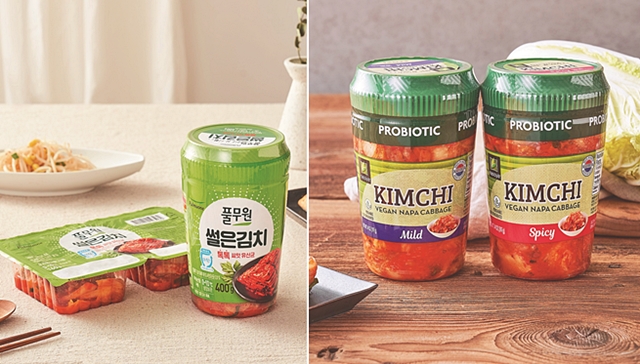
Recently, demand for Korean kimchi has been exploding since the worldwide popularity of Corona 19. This is because there has been an announcement from academia that kimchi, a fermented food, helps boost immunity against viruses, which has led to increased consumption among people around the world.
Thanks to the Korean kimchi syndrome, exports of Pungsan Kimchi in Andong, North Gyeongsang Province, were also brisk. Exports of Pungsan Kimchi reached 3.35 tons (1.06 million dollars) last month, up more than 30 percent from 241 tons (850,000 dollars) in the same month last year. In particular, the figure jumped 60 percent year-on-year in the April-June period, and exports are expected to increase more than 50 percent this month compared to last year.
According to the Ministry of Agriculture, Food and Rural Affairs, the accumulated amount of kimchi exports reached $74.7 million by the end of June this year, up 44.3 percent from a year earlier. In particular, exports to the U.S., which suffered severe damage from Corona 19, increased 61.7 percent from last year.
Jean-Busuke, an honorary professor at Montpellier University in France, who served as president of the World Federation for the Elimination of Chronic Respiratory Diseases under the World Health Organization (WH0), recently said, “In countries with low corona 19 fatality rates, such as Korea and Germany, there is a clue to the eating habits of fermented food.”

Nabe S&F’s vegan kimchi was completed in an extension of Shim Young-soon’s kimchi research. It is kimchi for vegans that do not have salted fish or any animal ingredients. The study found that it was salted fish that affected the fermentation of lactobacillus, but it was confirmed that there was no difference, and the flavor was alive even without salted fish.
It is characterized by a clean taste by replacing salted shrimp with garlic from regular kimchi.
Under these circumstances, Korean companies are also rushing to export their Jonggajip Kimchi, which rose to $26 million in 2015, $29 million in 2016, $32 million in 2017, $37 million in 2018 and $43 million last year, and exported $30 million in the first half of this year. Kimchi exports in the first half of this year account for 41 percent of Korea’s total kimchi exports.
CJ Cheiljedang Corp. is also seeing a steep increase in its overseas shipments. Exports in the first half of this year increased by 30 percent compared to the same period last year. Among them, CJ CheilJedang’s flagship “Vibigo Gaji Kimchi” sales rose 80 percent from the same period last year.